

2026 World Soil of the Year
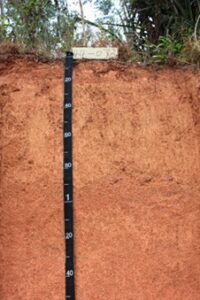
Acrisol from Guangdong, Subtropical China
The “Acrisol from the Low Hills of Southwestern Guangdong, Subtropical China,” has been officially named the World Soil of the Year 2026. The Soil Science Society of China (SSSC) proposed this soil.
Acrisols are highly weathered, acidic soils primarily distributed across humid tropical, subtropical, and warm temperate regions, covering just under 8% of the Earth’s continental land surface. They are found in old, stable landscapes with hilly or undulating topography on the contents of the (North- and South) Americas, (South-East) Asia and Africa. Acrisols have a subsurface layer of accumulated poorly fertile (kaolinitic) clays. They are deep, well-drained soils, often with yellow brown to red colours, though they can vary from sandy clay loam to clayey textures. The aggregate stability of the topsoils is low, which makes these soils highly erodible. If not under natural vegetation, maintaining a good soil cover and avoiding soil disturbance by machinery (ploughing, logging operations) is crucial. Therefore perennial (tree and plantation) crops are sustainable use for these soils.
World Soil of the Year 2026: Acrisol from the Low Hills of Southwestern Guangdong, Subtropical China
The deep soil profile (>100 cm) is in a low hilly landscape in southwestern Guangdong, China, governed by a maritime monsoon climate and has been formed on residual and colluvial deposits derived from granite weathering. The region provides a stable foundation for agriculture and forestry. A large part of the Acrisols in this part of China, especially in low hills and on gentle slopes, are cultivated for growing tropical fruits, maize, sweet potato, and other upland crops. Much of these soils in this region are under forest, supporting economically important tree species such as slash pine, eucalyptus, rubber, and litchi, as well as serving as a habitat for agarwood (Aquilaria sinensis, locally known as “Chen Xiang 沉香”) a highly valued medicinal and aromatic tree. The soil is poorly fertile and has an acidic to strongly acidic reaction (pH 4.0–5.0), especially in the subsoil. Ecologically, this soil is key to regional stability, supporting natural and planted forests of eucalyptus, shrubs, and herbs that enhance cover and sequester carbon. It stores and channels water, regulating local hydrology, while providing refuge for forest-adapted species and safeguarding biodiversity. Under sustainable management, such as mixed conifer-broadleaf planting, it also reduces erosion and boosts ecosystem resilience.
Classification WRB
Xanthic Ferralic Acrisol (Hyperdystric, Ochric)
Chinese Soil Taxonomy
Typic Hapli-Udic Ferralosol(普通简育湿润铁铝土)
More information on the World Soil of the Year 2026 from Guangdong
2025 IUSS World Soil of the Year
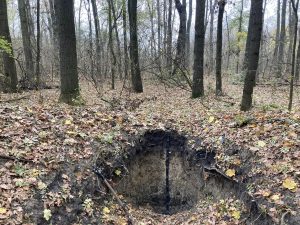
The “Gleysol,- Hydromorphic soil supporting forest growth in the steppe region from the Carpathian Basin”, has been officially named the World Soil of the Year 2025. This soil was proposed by the Hungarian Soil Science Society. It highlights the significance of these unique soils that have a large global coverage, occurring in nearly all climates.
The represented World Soil of the Year soil profile is located on Püspökladány Experimental Station and Arboretum University of Sopron Forest Research Institute (SOE-ERTI).The soil is part of a unique cultural landscape dominated by grasslands and salt effected pastures in the Hungarian Plain. It is located within the Hortobágy National Park, which is a UNESCO Biosphere Reserve (Man and the Biosphere Program – MAB) and recognized UNESCO World heritage site.
Gleysols are soils that are affected in various areas in the world by land use and management and the indirect and direct effects of climate change. Salinization of groundwater, decreasing groundwater levels and alternation of sediment influx are common.
The election of the ‘Gleysol – hydromorphic soil from the steppe region in the Carpathian Basin’ as the World Soil of the Year 2025, comes amid growing global concerns about soil health and environmental change. Protecting and sustainably managing these hydromorphic soils is essential for mitigating floods, preserving water quality, and ensuring sustainable forest ecosystems in steppe terrains.
Various activities are planned throughout the year to celebrate this achievement, including educational programs, community workshops, and conservation initiatives aimed at promoting awareness of Gleysols’ ecological significance.
World Soil of the Year elections
In recognition of the success of various national programs, the IUSS WSY program has been implemented to enhance soil literacy across numerous countries and on a global scale. It is expected that this will aid in compiling a registry of soil heritage, to recognize the inherent natural and cultural values of soils, thereby helping to open doors for soil science to integrate with environmental protection activities and projects.
More information on the World Soil of the Year the Gleysol from the Carpatian Plain can found here:
World Soil of the Year 2025 – Gleysol from Carpatian Plain.pdf
2024 IUSS World Soil of the Year
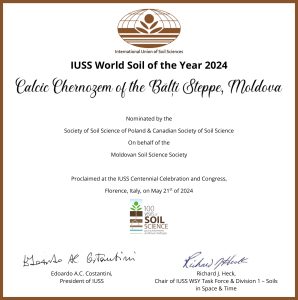
The “Chernozem of the Balti Steppe, Moldova” was officially proclaimed as the inaugural “IUSS World Soil of the Year” during the closing ceremony of the 2024 Centennial Congress and Celebration in Florence. Official nomination of this soil was provided by the Soil Science Society of Poland and the Canadian Society of Soil Science, on behalf of the Moldovan Society of Soil Science. Dr. Boris Boincean received the award from IUSS President Edoardo Costantini, on behalf of the Moldovan Society of Soil Science, and then provided an overview of the Chernozems of the Balti Steppe. This was complemented with a presentation, by Dr. Cezary Kabala (Chair of the IUSS WRB Working Group), on the global significance of chernozemic soils. Further information regarding the 2024 IUSS WSY can be obtained by contacting Dr. Boincean (bboincean@gmail.com).
In recognition of the success of various national programs, the IUSS WSY program has been implemented to enhance soil literacy across numerous countries and on a global scale. It is expected that this will aid in compiling a registry of soil heritage, to recognize the inherent natural and cultural values of soils, thereby helping to open doors for soil science to integrate with environmental protection activities and projects. A dedicated webpage is currently being developed for the WSY program on the IUSS website.
To support promotion of the 2024 IUSS WSY, a special issue of Geoderma Regional will be published with a focus on chernozemic soils internationally – this is now open for submissions. Further details can be obtained by contacting Cezary Kabala (cezary.kabala@upwr.edu.pl).
Efforts are also currently underway to convert the IUSS WSY Task Force to a regular Working Group within Division 1 – Soils in Space and Time. In the meantime, the call for nominations for the 2025 IUSS WSY is already open. Inquiries, regarding either participating in the Task Force/Working Group or the 2025 IUSS WSY call, can be directed to the Chair of Division 1, Richard J Heck (iuss.div1@gmail.com).
IUSS World Soil of the Year Working Group
Stephan Mantel – Chair / stephan.mantel@wur.nl
Jose Joao L. L. De Souza – Vice-chair / jjlelis@ufv.br
Boris Boincean – member
Cesary Kabala – member
Daniela Sauer – member
David Badia-Villas – member
David Dent – member
Edoardo Constantini – member
Eduardo Guimaraes Couto – member
Klaus Jarosch – member
Péter László – member
Pierre Roudier – member
Richard Heck – member
Sergey Goryachkin – member
Read more
https://www.ufz.de/export/data/2/260235_AltermannetalChernozemBL.pdf
You must be logged in to post a comment.